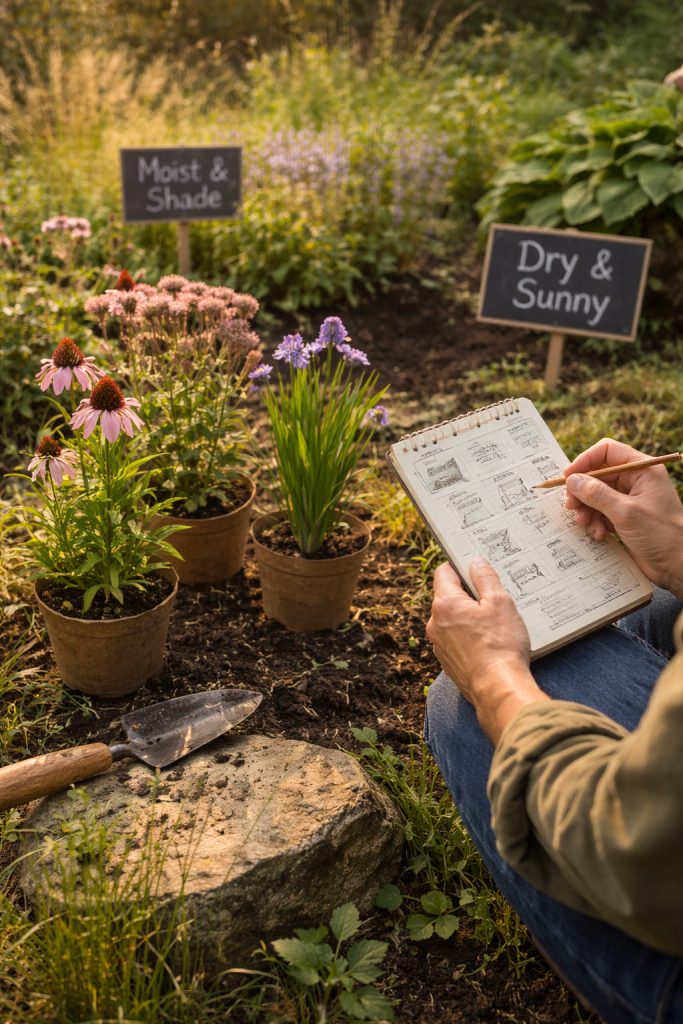
The best way to know what to plant is to first observe your garden’s natural conditions. By watching light, soil moisture, wind, and existing plants over time, you begin to understand what already thrives. This allows you to choose plants that belong, rather than forcing ones that struggle.
There is a moment, before the first plant is bought, before the soil is turned, where the garden is already speaking.
Most people miss it.
They arrive with intention, with sketches, with lists of what they want to grow. They step into a space and immediately begin to imagine what it could become, rather than asking what it already is. And in that quiet misstep, the conversation with the land is lost before it has even begun.
This guide asks you to do something deceptively simple.
Do nothing.
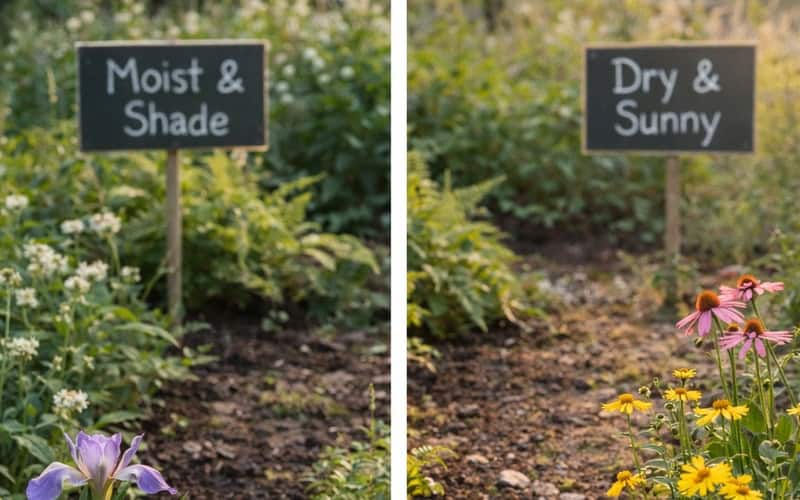
Or rather, do nothing except notice. Always read your garden before planting.
Why Observation Matters Before Planting
Choose a small area of your garden. It does not need to be grand. A corner, a strip along a fence, a patch near a doorway. Return to it in the morning, and again in the late afternoon, for seven days. Stand still. Let your eyes adjust, not just to what is there, but to what is changing.
How to Read Your Garden
Watch how the light moves across it. Where does the sun linger, and where does it disappear too quickly? Notice where the soil holds moisture after rain, and where it dries and cracks. Feel the wind — not just its presence, but its direction, its persistence, its temperament.
Look closely at what is already growing.
What Existing Plants Can Tell You
The plants you may have dismissed as weeds are often the most honest indicators of your conditions. Moss tells you about moisture and shade. Plantain speaks of compaction. Clover hints at nitrogen and resilience. These are not problems. They are messengers.
Learning from Insects and Movement
Observe the insects. Where do they gather? What do they avoid? Life is always revealing preference, and preference is the first language of ecology.
Resist the urge to tidy, to correct, to improve.
Let the space remain as it is long enough for you to understand it—without interference.
There is humility in this. A softening of the instinct to control.
By the end of the week, you will begin to see patterns.
Not dramatic ones, but quiet consistencies. A place that never quite dries. A corner that is always in shade. A path of wind that bends everything in one direction. These are not limitations. They are invitations.
Native planting does not begin with selecting species. It begins with learning the character of a place.
When you understand that character, the right plants are no longer choices you impose. They are answers that reveal themselves.
And at that moment, you are no longer designing a garden.
You are entering into a relationship with it.
A Simple Way to Begin
Choose one small area of your garden
Visit it morning, midday, and evening
Notice light, moisture, and wind
Observe what is already growing
Resist changing anything for at least one week
This is where the work begins—not with planting, but with understanding.
When you begin to understand what your garden is telling you, the next step is not to choose plants at random—but to find those that already belong to your place.