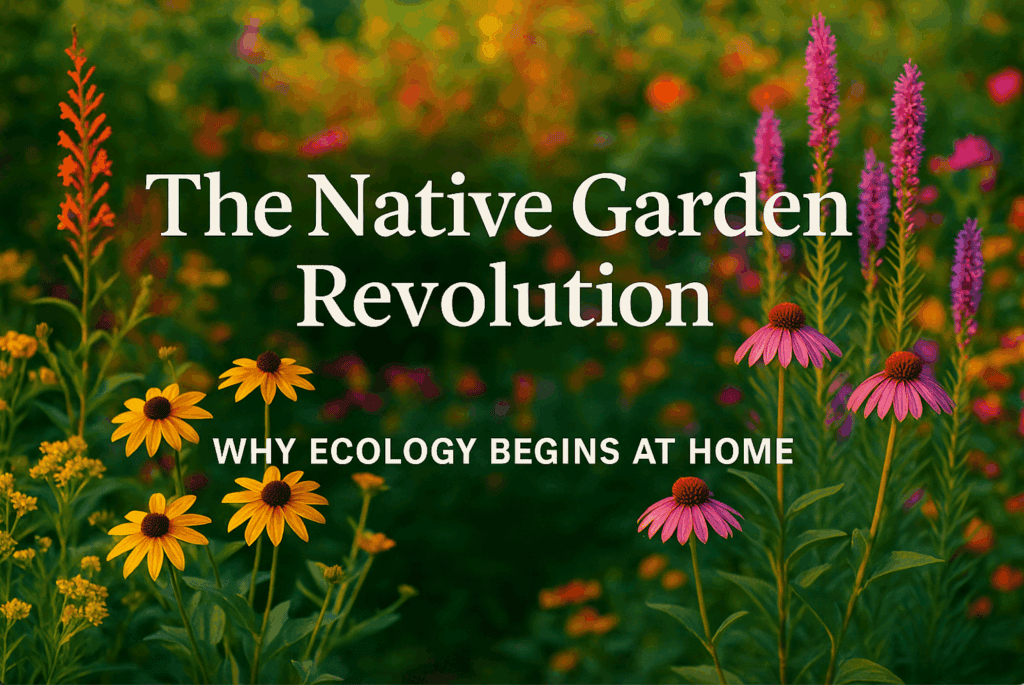
Why Ecology Begins at Home
A New Way to See your Garden
For generations, we were taught that a good garden was a tidy one. Straight borders, clipped hedges, and exotic flowers chosen more for their color than their connection to place. Lawns rolled out like carpets — green but lifeless — and fertilizers kept everything unnaturally bright. Beauty, we were told, was control: a garden disciplined into submission.
But nature’s definition of beauty has always been different. It’s not built on symmetry or polish, but on balance. On relationships. On the quiet cooperation between soil and seed, bird and berry, root and rain. The kind of beauty that doesn’t ask for admiration — it asks for participation.
The Native Garden Revolution is about returning to that truth, while incorporating ecological gardening principles. It’s not about rejecting gardening as we know it, but about remembering why we garden at all.
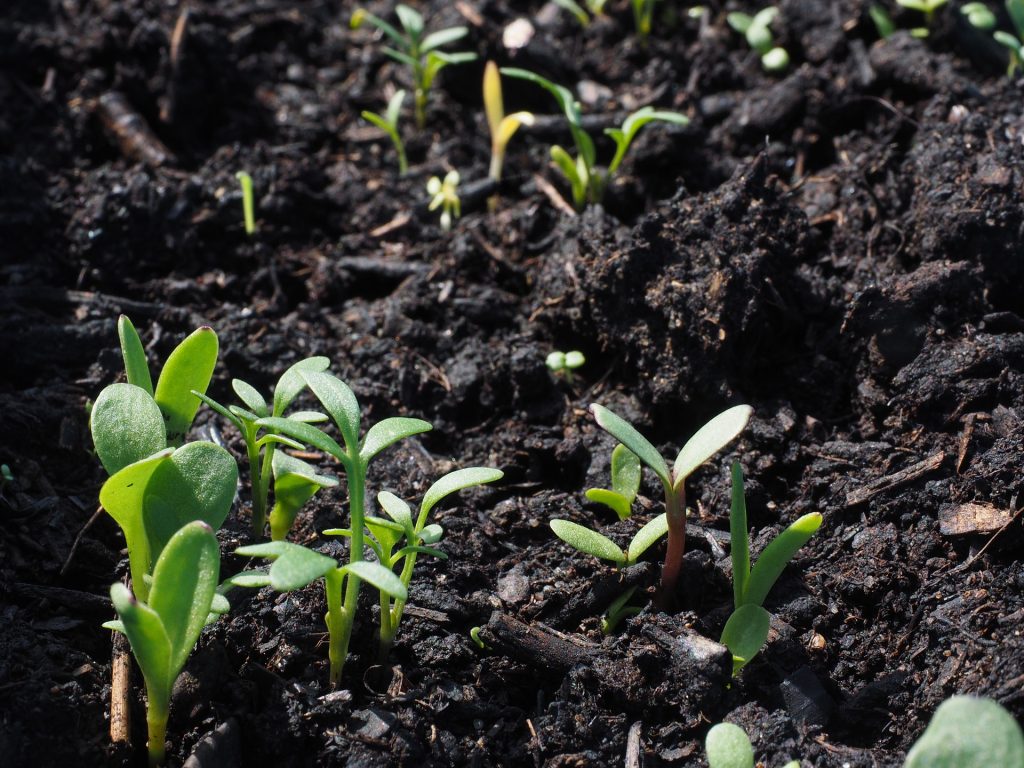
When we plant a seed that belongs — a native flower, a wild grass, a tree that feeds — we participate in something ancient and generous. We begin to restore the language of the land with native plants and local ecosystems
Every garden, no matter how small, can become a sanctuary. A city balcony spilling with pollinator plants. A suburban border buzzing with life. A rural acre stitched together with native trees and meadow grasses. Each space, tended with care, has the power to rebuild the web of life that once thrived where we now live.
And every gardener, whether novice or seasoned, becomes part of that quiet transformation — a steward of renewal, an ally to the unseen. Because when you garden with nature instead of against it, you don’t just change your surroundings. You change your way of seeing the world.
This is where ecology begins — not in distant wildernesses or government policies, but right here, in our own backyards. In the soil beneath our feet. In the small daily gestures that remind us that to care for the earth is to nurture ourselves.
Why Native Plants Matter
Native plants are not just pretty choices — they are purposeful ones. These are the species that have evolved alongside your region’s soil, climate, insects, and wildlife. When you plant native, you create a living bridge between your garden and the wider ecosystem.
Biodiversity blooms: Native gardens attract bees, butterflies, birds, and beneficial insects that depend on specific native flowers and seeds.
Water stays local: Native roots reach deep, holding soil in place and reducing runoff.
Balance returns: Without fertilizers or pesticides, native plants thrive naturally, restoring soil health and microbial life.
A biodiversity garden is not wild by accident — it’s alive by design.
Rethinking “Beautiful”
For too long, beauty in the garden has been defined by uniformity — straight edges, perfect blooms, clipped hedges, and lawns trimmed to an inch of submission. But this idea of perfection has often come at a cost: sterile soil, silenced pollinators, and landscapes that please the eye but starve the earth.
An ecological garden asks us to see differently. It invites us to loosen our grip and open our senses. In this kind of garden, the edges soften, grasses sway freely, and wildflowers volunteer where the wind has carried their seed. The color palette shifts like a slow-moving symphony — vibrant with pollinator life in spring, rich with golds and russets in autumn, quiet and skeletal in winter’s rest. Every phase carries its own form of grace.
Here, seed heads are not mess, but architecture. Leaf litter isn’t waste, but blanket — shelter for insects, nourishment for soil. The once-dismissed tangle of stems becomes a refuge for overwintering bees and ladybirds, while the quiet corners, left untamed, hum with the soft rhythm of unseen lives.
When you let go of control, something miraculous happens: the garden begins to teach you. You start to notice the conversation happening all around you — the murmur between bee and bloom, the swift flash of a wren darting through the grasses, the way raindrops linger on seed pods as if reluctant to leave. You realize that beauty is not in the tidy, but in the alive.
This is sustainable landscaping in its truest form — gardening not against nature, but with it. It’s a slow-moving collaboration, a living dialogue. The gardener becomes not a designer imposing will, but a caretaker restoring harmony.
And in that moment of surrender — when you accept the imperfect, the seasonal, the ever-changing — you find a deeper kind of satisfaction. The garden ceases to be a stage and becomes a story, unfolding day by day, rich with meaning, movement, and the hum of life returning home.
Your Garden, Your Contribution
Every plant you grow, every square foot you protect, is part of something far greater than the space you can see. A milkweed by your fence might feed a monarch on its 3,000-mile migration. The berries from your native shrub may sustain a wintering thrush hundreds of miles from its breeding grounds. Even the smallest patch of wildflowers becomes a stepping-stone — a vital link in a chain of life that stretches across neighborhoods, counties, and coastlines.
What happens in your garden doesn’t stay there. It radiates outward — as food, as seed, as water, as oxygen. Your patch of earth hums with invisible exchanges: fungal threads passing nutrients from root to root, pollinators carrying pollen between yards, raindrops filtering through healthy soil into streams that feed the sea. Each act of care, each decision to plant native, sends a quiet signal through the web of life: this place is safe, this place belongs to life again.
Imagine if every gardener planted just one native tree, or turned one tidy bed into a buzzing pollinator patch. Imagine a country where lawns softened into meadows, where schools and businesses embraced living landscapes instead of concrete emptiness. The ripple would become a tide — an ecological renaissance beginning not in boardrooms or government halls, but in the hands of ordinary people with trowels, seeds, and hope.
At iGrowHort, we believe the future of gardening is regenerative, educational, and deeply personal. It isn’t about mastery — it’s about relationship. Each native plant you tend restores more than soil; it restores a sense of belonging. We grow not for control, but for connection — to the land, to one another, and to the quiet intelligence of nature itself.
So when you step into your garden, know this: you’re standing within something sacred. You’re part of the restoration. You are both gardener and guardian, tending not only what grows above the soil, but what thrives beneath it — and what, one day, will thrive because of you.
🌾 Closing Thought
The revolution doesn’t require a megaphone — only a seed, a patch of soil, and the willingness to see beauty differently. In doing so, we remember what the earth has been whispering all along: ecology begins at home.
Join the Movement
If you’re new to native plants, start small. A few wildflowers. A native grass. A shrub that feeds the birds. Let the garden teach you — it will.
We’re here to help you learn, grow, and find joy in the process. Explore our guides, seed collections, and stories at iGrowHort.com, and take your first step toward a more sustainable, biodiverse world — one garden at a time.
Further Reading: Growing Knowledge, Growing Connection
Every movement begins with learning — and the Native Garden Revolution is no different. The more we understand the ecology around us, the better we can care for it. Below are trusted, research-based organizations that expand on the principles of native planting, pollinator support, and sustainable landscape design. Each offers regionally tailored tools, practical guidance, and a deeper appreciation for the living systems just beyond your doorstep.
National Wildlife Federation – Garden for Wildlife
Garden for Wildlife is a cornerstone resource for anyone beginning their native plant journey. The National Wildlife Federation provides detailed plant recommendations, wildlife certification programs, and inspiring community stories. Their guides help transform gardens into certified wildlife habitats — places where birds, butterflies, and beneficial insects can safely thrive year-round.
Xerces Society – Native Plant Finder by Region
The Xerces Society for Invertebrate Conservation maintains an exceptional database of native plants organized by region. Each list highlights species that support pollinators, including specialist bees and butterflies unique to your local ecosystem. Whether you’re planting a window box or an acre, this tool makes it easy to choose ecologically valuable species suited to your climate and soil.
USDA Plants Database – Native Species by State
The USDA PLANTS Database is the most comprehensive national catalog of plant species found across the United States. Users can search by state, region, or scientific name to verify whether a plant is native, introduced, or invasive. It’s an invaluable tool for gardeners, educators, and conservationists seeking to plant with accuracy and ecological integrity.
Doug Tallamy’s Homegrown National Park
Entomologist Doug Tallamy’s visionary initiative, Homegrown National Park, turns the concept of conservation into a grassroots movement. It encourages homeowners, schools, and communities to plant native species and reconnect fragmented habitats across North America. Every yard counts toward a shared, continent-wide goal — rebuilding biodiversity one garden at a time.
Pollinator Partnership – Eco-regional Planting Guides
The Pollinator Partnership offers free eco-regional planting guides that match your ZIP code with the best native plants for pollinators in your specific area. Each guide includes bloom times, habitat notes, and plant combinations that maximize forage and nesting resources. It’s a practical way to align your garden design with the life cycles of bees, butterflies, and hummingbirds.
University of Delaware – Sustainable Landscapes
The University of Delaware’s Sustainable Landscapes program provides in-depth research and visual case studies on how to merge beauty with ecology. Developed by leading horticulturists and ecologists, this resource showcases real-world examples of how design, science, and stewardship can coexist — a fitting echo of the philosophy behind The Native Garden Revolution.
🌾 Closing Reflection
In every seed we plant, we participate in restoration — not just of landscapes, but of awareness. The resources above offer pathways to learn, adapt, and deepen our relationship with the natural world. Together, they form a living library for the next generation of gardeners: those who will see not only what grows, but what returns when we let the earth lead.