
Why should you observe your garden over time?
Observing your garden regularly helps you understand how light, moisture, plants, and seasonal patterns change. By returning to the same place over time, you begin to recognise what is stable, what is shifting, and how to respond with less intervention and greater accuracy.
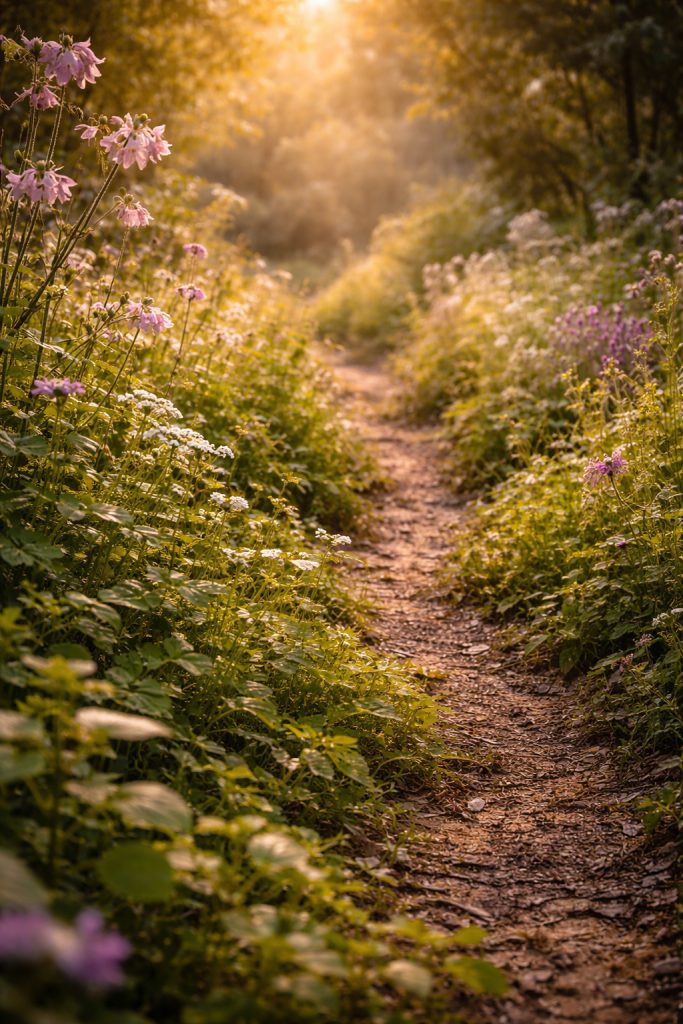
There is a path you come to know when walking the same path in a new gardening season.
Not because it changes, but because you return to it.
At first, it is simply a route — a way through the garden, a line between beds, a familiar turn past a tree or along a border.
You walk it without much thought, focused on what needs doing.
And then, over time, something shifts. You begin to notice in a new gardening season
The light falls differently than it did last week. A plant that was barely visible has emerged. Another has receded. The air carries a different weight. The ground holds moisture where it once felt dry.
The path has not changed. But the new gardening season has. And so have you.
What to Observe
Returning to the same place reveals what passing through it once could not.
Monitor seasonal light in a new gardening season
Light moves across the garden in shifting patterns.
In spring, it is soft and angled.
In summer, it becomes direct and full.
In autumn, it lowers and warms.
In winter, it sharpens and lengthens.
Each change reveals different aspects of the landscape.
Growth and Absence
What is present in one season may be absent in another.
Dense summer planting gives way to winter structure. Bare ground in early spring becomes full and layered by mid-season.
Presence and absence are part of the same cycle.
Texture and Form
Without flowers, form becomes visible.
Grasses, stems, branches, and seedheads define the space in quieter ways. Structure replaces colour as the dominant language.
In later seasons, seedheads begin to replace flowers as the defining feature. They catch the light differently. They hold structure through wind and frost.
What was once colour becomes movement and form. In this way, the garden continues to speak long after flowering has passed.
Movement Through Time
Patterns become clearer when observed repeatedly.
Where water gathers.
Where plants return.
Where shade deepens or recedes.
The garden reveals itself not in a single moment, but through accumulation.
The garden is never fixed.
It is always in response.
What Remains
Not everything shifts with the season.
Some patterns hold. Water gathers in the same places.
Certain areas remain dry, or shaded, or exposed. Some plants return, year after year, to the same ground. These consistencies are not static—they are structure. They are what the rest of the garden moves around.
What it Means
To walk the same path in different seasons is to understand that the garden is never fixed.
It is not a finished composition.
It is a living system in continuous change.
When we return to the same place with attention, we begin to see beyond individual moments. We notice relationships, rhythms, and cycles.
The garden becomes less about what it is at any given time, and more about how it moves.
Belonging, in this sense, is not a static condition.
It is participation in that movement.
A Simple Way to Begin
Choose one path.
Walk it at the same time each week.
Do nothing at first—only observe.
How to Respond
The role of the gardener becomes one of return.
Walk the same spaces regularly.
Observe change without rushing to respond.
Allow time to reveal patterns.
Make adjustments slowly, informed by repeated observation.
Accept that understanding develops over seasons, not days.
The garden does not require constant action.
It requires continued presence.
Seasonal Notes
Each season offers a different way of seeing.
Spring
Emergence draws attention to beginnings and potential.
Summer
Fullness reveals abundance, pressure, and balance.
Autumn
Decline shows structure, seed, and preparation for rest.
Winter
Stillness exposes form, soil, and underlying systems.
In different parts of the world, these seasonal expressions may shift.
In some climates, change is defined by wet and dry cycles rather than temperature.
In others, the growing season is shorter, or extended.
But the principle remains the same.
The path does not change.
The rhythm does.
Field Practice
Choose a single path in your garden.
Walk it regularly throughout the year.
Do not change anything along it at first.
Observe how the space feels in different seasons, what appears and disappears, how light and shadow shift, and where life concentrates and where it withdraws.
Record your observations.
Over time, the path becomes more than a route.
It becomes a record of change.
Closing Reflection
The garden does not end.
It returns.
What was learned in one season is tested in the next. What was observed becomes clearer over time. What felt uncertain begins to settle into understanding.
The same path, walked again, reveals something new.
And in that repetition, something else emerges.
Not control.
Not certainty.
But familiarity.
A sense of place.
A sense of rhythm.
A sense of belonging.
Over time, the path becomes more than a route.
It becomes a reference point—something steady against which change can be understood.
And from that understanding, better decisions begin to emerge.
Closing Transition
This is where the series began—
with the idea that a garden must first be read, not controlled.
And from here, the next step is not to act immediately,
but to recognise what truly belongs to your place.
Now, having walked through observation, soil, belonging, restraint, relationship, specificity, completion, and care, we arrive back at the same point.
Only now, it is seen differently.
The garden has not changed. But we have learned how to see it.