
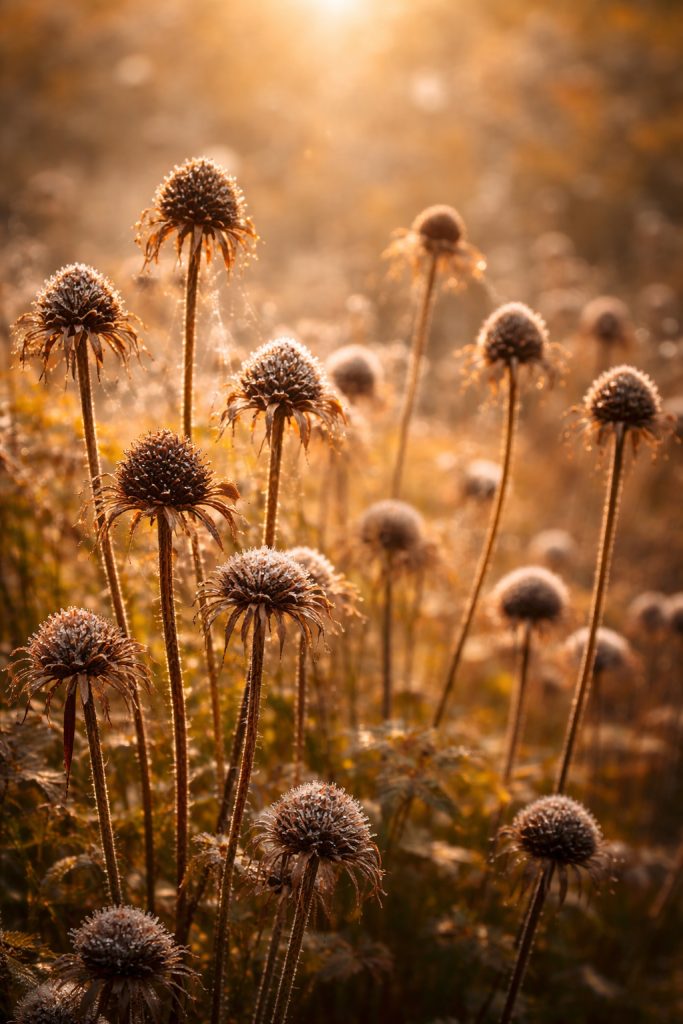
Should you leave seedheads standing in the garden?
Leaving seedheads standing supports birds, insects, and soil health through autumn and winter. Seedheads provide food when resources are scarce, offer shelter for wildlife, and add structural interest to the garden long after flowering has ended.
There is a moment in late autumn when the garden feels finished.
Flowers fade. Colours soften. Stems lean and dry. The instinct to tidy becomes almost automatic — to cut back, to clear, to restore order before winter arrives.
It feels like the right thing to do.
And yet, if we pause, something else becomes visible.
The garden is not finished. It is completing itself.
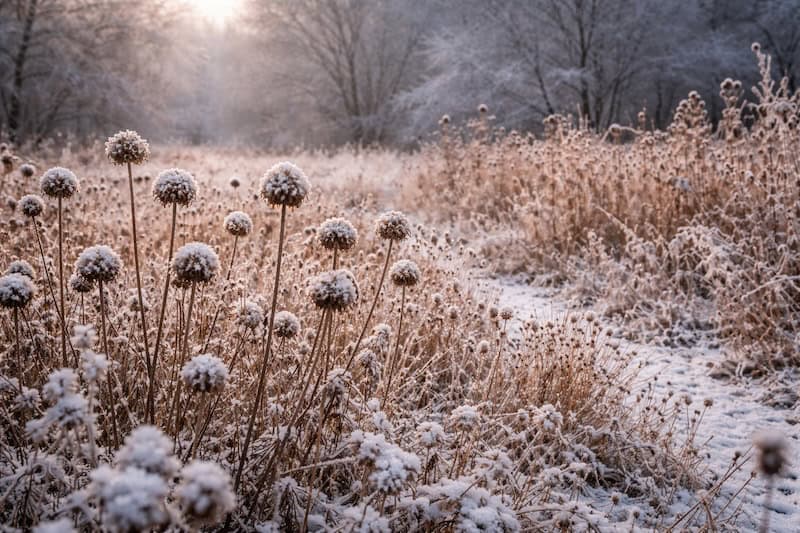
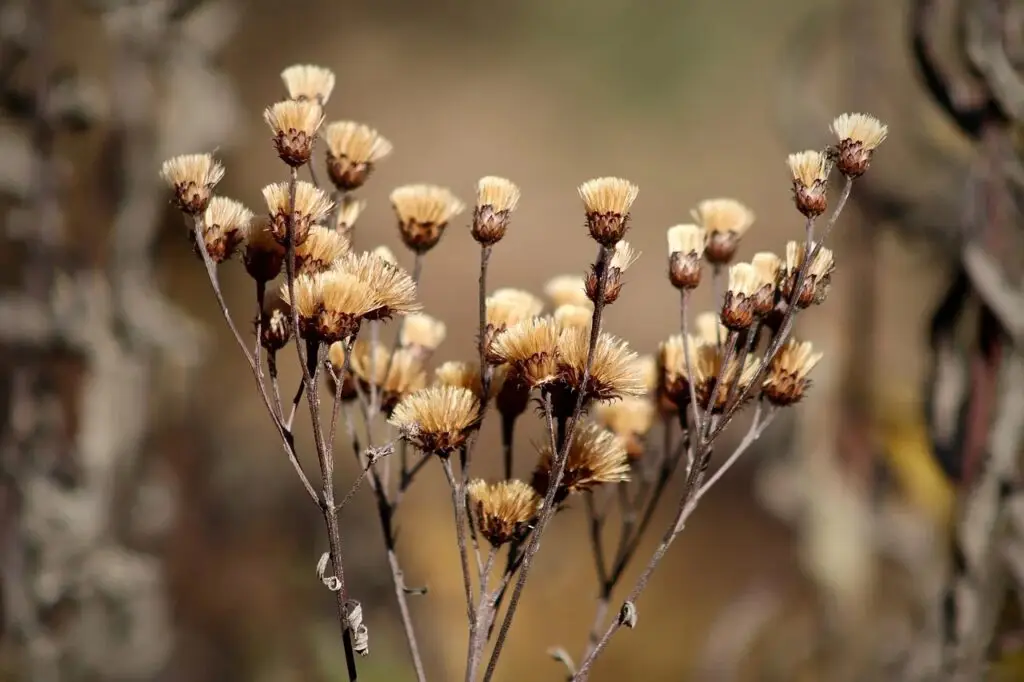
To leave seedheads standing is to hold form against the changing light. Grasses catch the wind. Birds move quietly through the structure, feeding and sheltering. Frost gathers where flowers once bloomed.
What appears to be decline is, in fact, continuation.
To leave seedheads standing is to recognise that the life of a plant does not end at flowering.
What to Observe
Completion reveals a different layer of the garden.
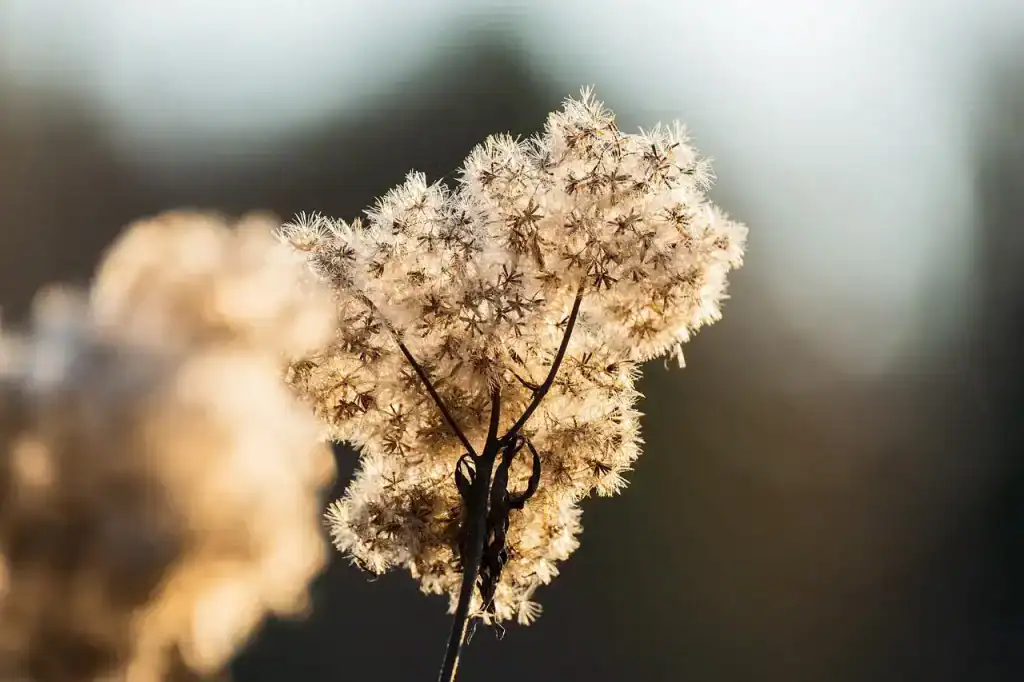
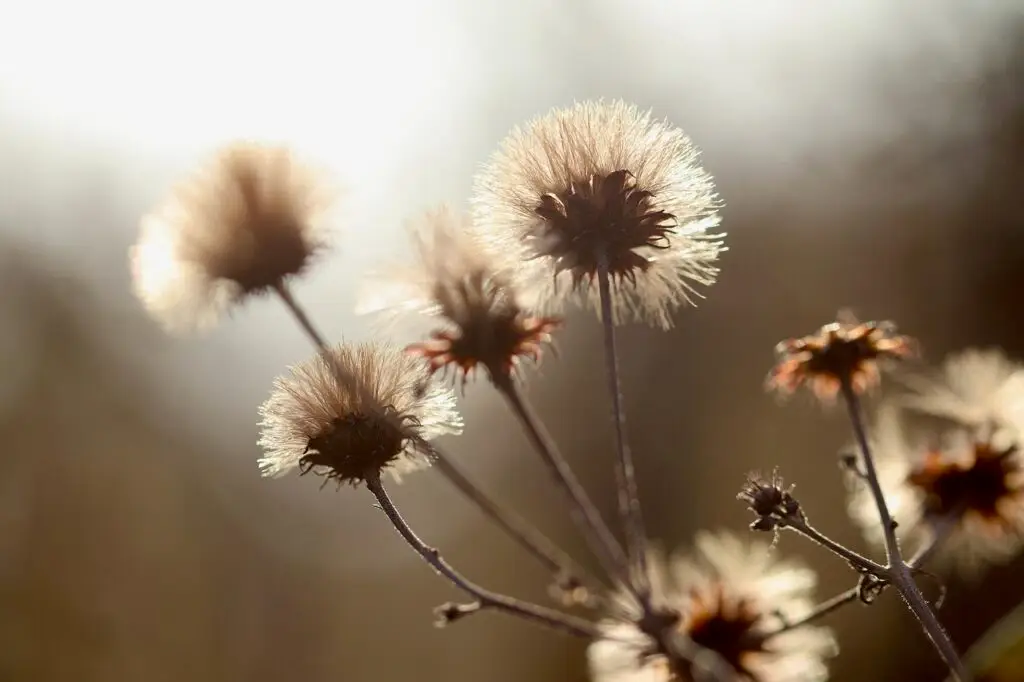
Structure without flower, without colour, the architecture of plants becomes visible. Seedheads hold the memory of the plant.
Where flowers once drew attention, form now takes over—shape, line, and movement replacing colour.
In low light, frost, or wind, they become more visible than they ever were in bloom.
Stems, seedheads, and grasses define space in a quieter way. The garden’s underlying form emerges.
Wildlife Activity
Seedheads provide food for birds and fifth season habitat for insects.
Observe movement through the garden — small, consistent, and often unnoticed during more active seasons.
Seasonal Light
Low autumn and winter light interacts differently with plant structure.
Shadows lengthen. Frost highlights texture. Subtle forms become more pronounced.
Natural Decay
Plants begin to break down gradually.
This process returns nutrients to the soil and prepares the system for renewal.
Seedheads are not remnants. They are continuation.
They are part of the cycle.
What It Means
Allowing plants to complete their cycle changes how we understand the garden.
It is no longer defined by peak bloom alone. Seedheads are not only visual structure—they are ecological infrastructure.
They provide food for birds when little else is available, shelter for overwintering insects, and protection for the soil beneath.
It becomes a continuous system — one that moves through growth, maturity, decline, and return.
They support wildlife.
They protect soil.
They carry the next generation.
In leaving them, we shift from maintaining appearance to supporting function.
What Changes When You Leave Them
The garden becomes less immediate.
It slows.
Instead of clearing and resetting, it holds its structure through the colder months.
Wildlife remains present.
The soil is protected.
The cycle is allowed to complete.
What changes is not just the garden—but the way you respond to it.
How to Respond
The response here is not action—but restraint. Restraint takes a different form in this stage.
Delay cutting back until late winter or early spring. Allow seedheads and stems to remain through colder months. Remove only what poses a clear issue — safety, disease, or obstruction.
Accept a looser, more natural aesthetic.
Recognise that what appears untidy often has purpose.
The garden is not being neglected. It is being allowed to complete its work.
Seasonal Notes
Completion is most visible in the transition from autumn to winter.
Autumn
Seedheads form and begin to dry. Wildlife activity increases around food sources.
Early Winter
Structure holds. Frost and snow interact with plant forms, revealing texture.
Mid Winter
The garden becomes quiet, but remains active beneath the surface.
Late Winter
The moment approaches when intervention becomes appropriate again — but not before.
In different climates, this period of completion may not align with cold.
In warmer regions, it may follow a dry season.
In others, it may be less visible but still present. The form changes. The function does not.
A Simple Way to Begin
Leave one area of your garden untouched through autumn and winter.
Observe what holds structure, what attracts wildlife, and how the space feels over time.
Field Practice
Select an area of the garden and leave it untouched through autumn and winter.
Observe which plants hold structure, which attract wildlife, how the space changes under frost and snow, and how the soil beneath responds.
Compare this area to one that has been cut back.
The difference will be instructive.
Transition
As we allow plants to complete their cycle, another question begins to emerge.
What is guiding our decisions?
Care—or control?
Are we acting out of care for the system, or out of a need for control?
The difference is subtle, but significant.
It shapes not only what we do in the garden, but how the garden responds in return.
And this leads to the next distinction:
The difference between care and control.